
Beware the Misinformation Machine: How Crypto Noise Makers Manipulate Social Media
How to protect Your portfolio from misinformation

Misinformation is rife in the crypto world. That’s done nothing to boost crypto’s reputation.
But crypto influencers on platforms like Twitter, Instagram, Facebook, and LinkedIn are desperate for attention. They want reader engagement in the form of retweets, shares, and likes.
How far are they willing to go?
Too far. Too many are willing to spread misinformation about crypto in pursuit of engagement.
So how do we separate valid information from utter garbage?
TLDR
Misinformation is everywhere, but it’s most prominent on social media.
People spread misinformation primarily to farm engagement – likes, retweets, and so on.
Presenting half-truths and selective facts as “breaking news” does nothing more than confuse people.
The information we take in ultimately influences our decision-making.
Finding credible sources of information is key.
Disclaimer: Not financial nor investment advice. Any capital-related decisions you make are your responsibility and yours only.
Misinformation for retweets
Many Twitter accounts are maintained by great people and companies that provide accurate information. But there are also engagement farmers.

Exhibit A. Notorious on Twitter for sharing what can only be described as utter nonsense, Mr. Whale has made quite a name for himself. Labelling himself an “Unbiased + Contrarian Investor” is like Bernie Madoff calling himself a legitimate businessman.

·
I’ve said it for years. #Binance is running a similar Ponzi as FTX.
Binance has control over:
the largest volume exchange
the largest crypto media site
the largest crypto ranking site
When this fraud goes bust, it will be 100x worse than tiny FTX!
Share
Here’s one of his latest tweets – no sources, nothing but a biased statement written to appear factual. Binance is the largest crypto exchange, but that’s irrelevant to the assertion that it’s a massive Ponzi scheme. #1 Source for Unbiased Crypto News? Sure… based on what metrics?
·
Over 90% of all #Bitcoin trade volume goes through Binance.
A corrupt Chinese exchange that is guilty of money laundering, fraud, price manipulation & much more.
When they go bust, don’t act surprised. The warning signs were all very clear.
Share
The purpose of these tweets is not to provide news, but to attract attention. It’s pure engagement farming. In fairness, he got us – we’re writing about him now.
But just because a source looks legit does not mean it is. “Sources” like Mr. Whale build up a huge following from those who don’t know any better. How do they become so successful?
BREAKING: The misinformation formula
Having a contrary opinion is great. But holding a contrary opinion just to present yourself as a “better” source of information is ridiculous.
It’s a purely psychological game. People want to think they know more than the “sheep.” They equate being contrary with being independent. So they disregard what’s known as fact and buy into contradictory stories based on partial truths.
Why? Because it goes against the consensus. It comes from an avowed insider who seems to be using his unique position to share an unvarnished truth that you can’t get anywhere else. It’s a seductive sales pitch.
These accounts feed egos. They provide talking points. They’re great at it – because they never let the truth get in the way of a good story.
In the long run, spreading misinformation benefits no one but the person who dreams it up – and maybe the product or service he’s shilling for.

·
One of the worst trends over the past few months has to be these breaking news accounts that just tweet for engagement citing their “sources” or steal from others.
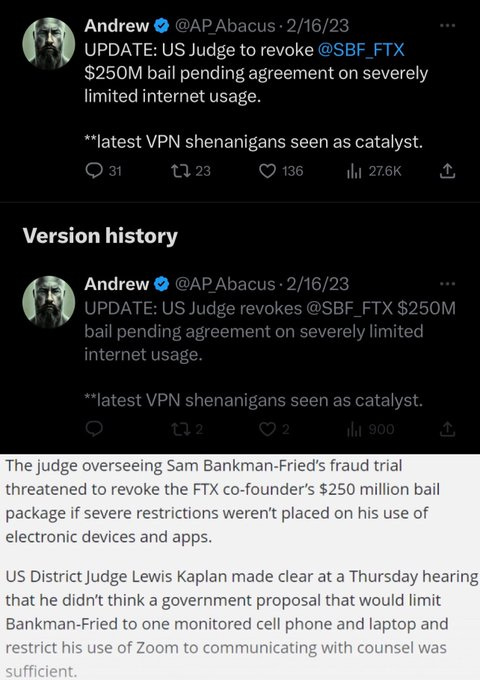

Read the full conversation on Twitter
Share
Here’s the recipe for crypto misinformation:
Find a popular topic or event that everyone is talking about.
Research the most common opinions.
Create a different opinion. It doesn’t really matter what it is, it just has to be different or controversial. No facts? No problem! Just make something up.
Outline your contrary opinion in an article, tweet, or social media post.
Put “BREAKING:” in front of the headline and post it.
Voila! With any luck, your malicious post will drive traffic to whatever shady book or website or subscription you’re trying to sell.
As a bonus, those who agree with your statements will argue your case in the comments. And the algorithms underlying social media platforms will drive more and more people toward your post as it becomes a flame point for readers.
The solution
We can’t force people to stop spreading misinformation. Free speech exists for a very good reason. All we can do is filter out the noise. And the best way to do that is by evaluating the information source.
Is the source trustworthy? What is the source’s track record? What are the source’s intentions?
These can be difficult questions. But where we get our information influences the decisions we make. It’s all about credibility. Making decisions based on misinformation or half-truths damages more than just our understanding of the market. It can have huge implications for our portfolios.
Primary sources don’t necessarily tell the truth, but at least they can be held accountable for lying. With primary sources, the information is “straight from the horse’s mouth.” Secondary sources are just as valid as long as they’re reliable and the information they share can be verified.
TMG’s take
In a world of misinformation, it can be easy to get caught up in believing what we want to be true. As investors, we must ensure we’re working with accurate information.
At TMG, we have make a virtue of skepticism, challenging everything we read and hear – even our own opinions. We work tirelessly to separate fact from fiction. It’s not an easy task, but it is a major source of the pride we take in our work.
With these tips, you can be more skeptical in your crypto dealings. It’s the Wild West out there – stay safe!
Action points
To evaluate information you find online, first, determine whether the source is primary or secondary. Primary means the post was made by the actual person or entity involved – like Sam Bankman-Fried making a statement on Twitter. Secondary means a third party is analysing or simply passing along the information.
Secondary sources must be evaluated. Is the source reliable? Has the source revealed or provided a link to a primary source?
If there’s no link to a primary source, is the information verifiable? Has it been shared elsewhere? Do a quick Google search to find out.
If a secondary source’s information is neither reliable nor verifiable, it’s best to disregard it.